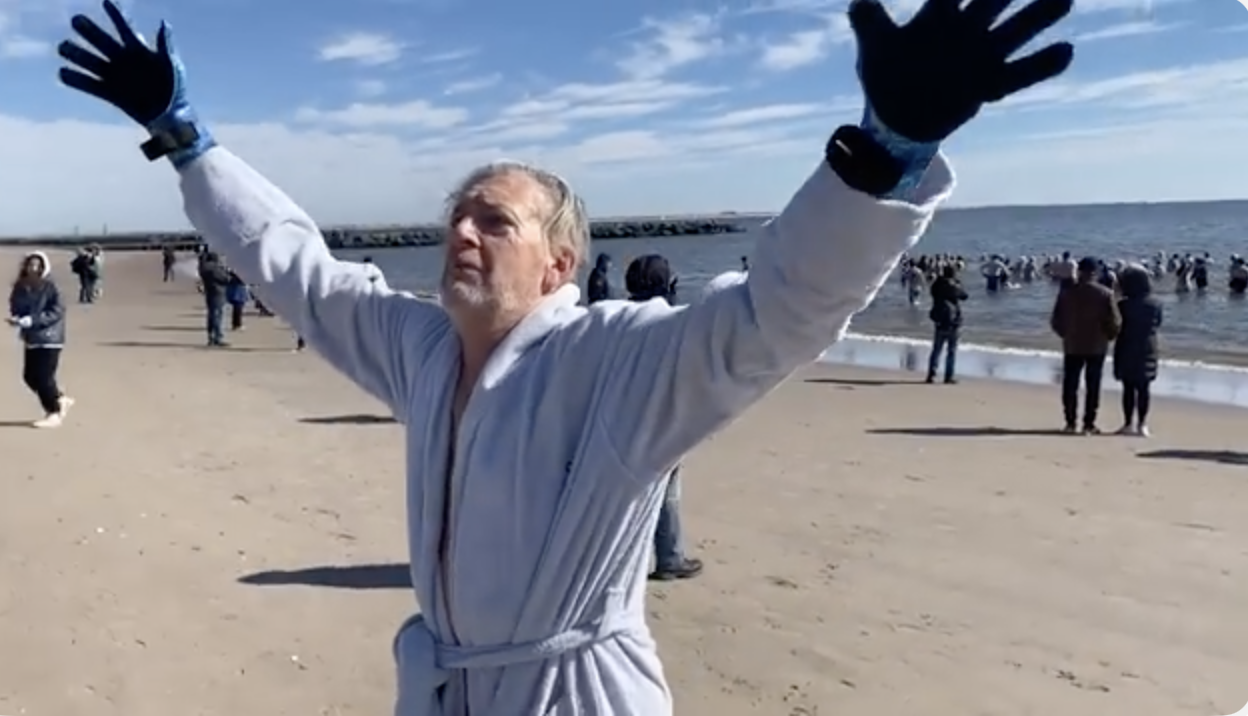
I began my writing journey after accolades from my elementary school teacher Miss Weidensee for a poem I wrote. I was seven years old, and I already knew two things: I would one day be old enough to marry her, and I would pursue the life of the writer she saw in me.
A lengthy stint of juvenile delinquency interrupted that pursuit — but also crystalized and directed it. I dropped out of high school at sixteen. But on reaching the age of eighteen, my juvenile escapades were now considered crimes, the latest of which would likely result in a six-month jail sentence. Panicked, I visited the local Army recruiter. It was the height of the Vietnam War. Delinquents, and newly promoted criminals, were all welcomed to enlist.
I got my GED in the Army, and through the GI Bill I was able to receive my BA from Illinois Benedictine College and my MA in Literature and Creative Writing from the University of Illinois at Chicago.
MASTER OF ARTS
For my MA thesis — An Autobiography of Jesus Christ — I had to choose three professors as my readers. As the title might suggest, there was no predefined genre for such creative writing back then. And the readers I chose, although considered “experimental” in their various published works of poetry and fiction, were not completely on board with my proposal.
THESIS
All three objected to a statement in my thesis outline asserting that the autobiography would be in perpetual process as I lived it, finished only when I died (not necessarily by crucifixion) or when I turned 33 years old. To the dismay of some of the professors in the MA program, and the encouragement of others, I submitted only “An Excerpt of An Autobiography of Jesus Christ” for all my writing assignments.
YEATS
For the final credits toward my MA, I chose a course study on William Butler Yeats. The professor, a prominent Yeats scholar, was confused when I submitted for my writing assignment “An Excerpt” that consisted only of images of Tarot cards laid out in sections labeled ACTOR, DIRECTOR, PLAYWRIGHT.
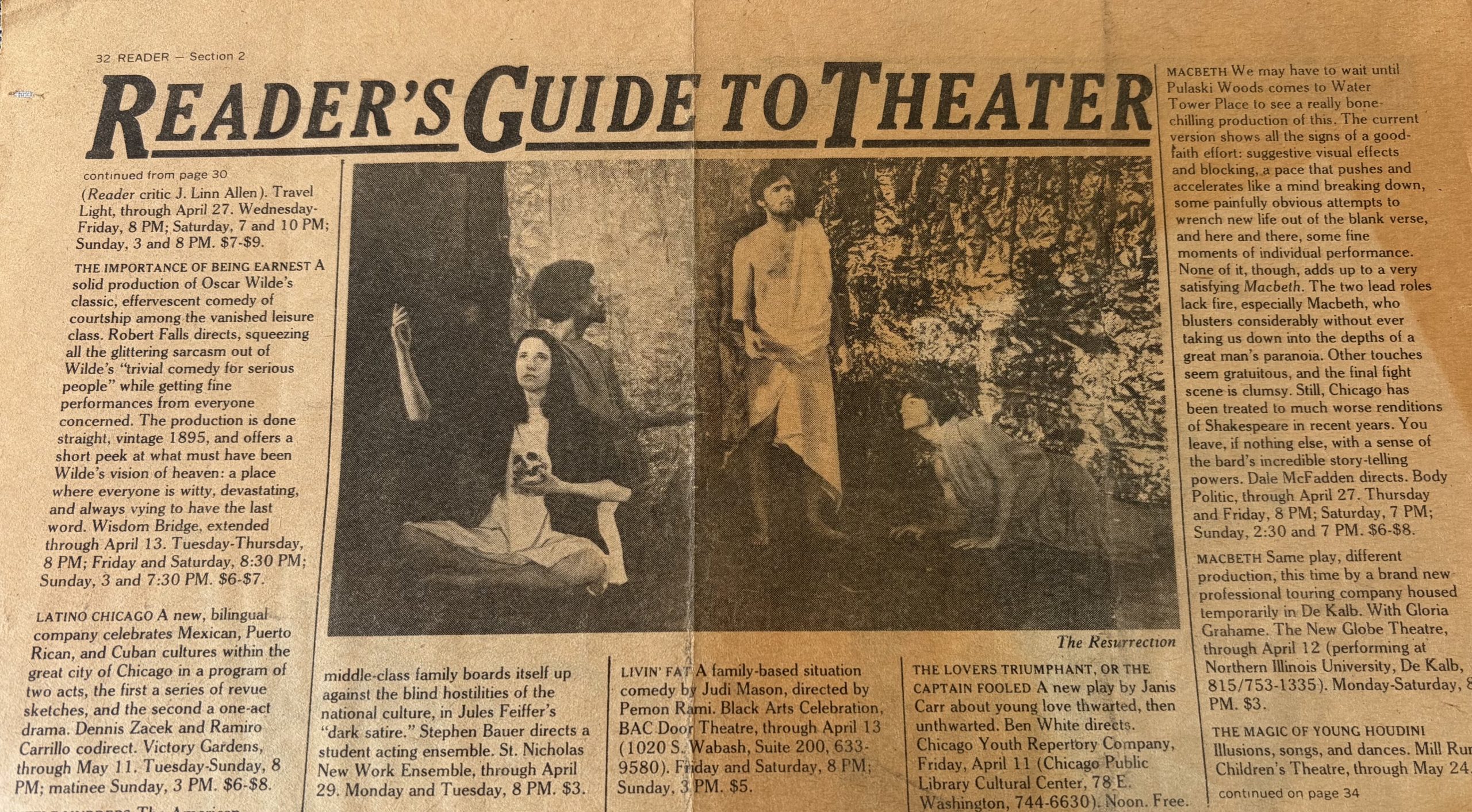
As “luck” would have it, at that same time, a small local Chicago theatre was mounting a production of Yeats’s chamber play The Resurrection. My metaphysics registered this “coincidence” as destiny and I auditioned for my first play. I was cast in a small walk-on part.
But most importantly, the playbill’s listing of characters and cast in one fell swoop justified my THESIS, my YEATS paper, and my entire MASTER OF ARTS degree.
DRAMATIS PERSONAE
The Hebrew –> David Calhoun
The Greek –> Richard Foster
The Syrian –> Robbi Davis
Jesus Christ –> Nick Fracaro
Acting in this production ended a chapter in my writing life as it simultaneously began another. I walked out of my graduate literature department, across the U of I campus to the undergraduate theater department, and into a casting call for Jean Genet’s The Balcony. I was cast in the production as Roger, the rebel leader and Chantal’s lover. The actor cast as Chantal was Gabriele Schafer, who would become my wife and life-long creative partner.
Gabriele and I, along with other teachers and students in that Balcony production, co-founded a theatre company and named it in honor of Jean Genet. In Thieves Theatre, I found not only an artistic home but also the next chapter of my writing life, writing being integral to the role of artistic director of a theatre. The instinctual impulses from my earlier life of delinquency and crime were never expunged. Instead, they had come full circle. In Genet’s writing and life, I found a role model that reflected my own journey. Genet summed it up perfectly:
“My ambition is to put my crime on stage.”
Through Thieves Theatre (later renamed International Culture Lab), I have been making trouble writing, performing, and producing theatre the whole of my adult life and I have the arrest record to prove it. I have always had a compulsion to disrupt the status quo, be it in politics, society, or art. Driven by that instinct I have spent decades producing edgy, site-specific, and physically daring work — from Chicago prison yards to Lower East Side squats to international stages.
When I’m not producing/directing, I’m performing; when I’m not performing, I’m writing.
My MA thesis at the University of Illinois at Chicago, An Autobiography of Jesus Christ, invented its own hybrid genre of autobiography, fiction, and performance art, where writing’s task becomes “enacting a life” rather than “recording a life.” This Performative Autofiction remains to this day the catalyst and inspiration for much of my writing. For instance, I have often (en)acted the Bird of Prayer character in productions of my play Travelling Light. In 1982 when the renowned Lower East Side squat, ABC No Rio, commissioned bringing a Chicago production of the play to NYC, I purchased a used Chicago Police paddywagon. Like my character, the long-haul trucker Bird of Prayer, I loaded up my “vehicle of knowledge” with the set, cast, and crew of the production and drove to NewYork “flying down a man-made road at a God-like speed. Travelling Light.”
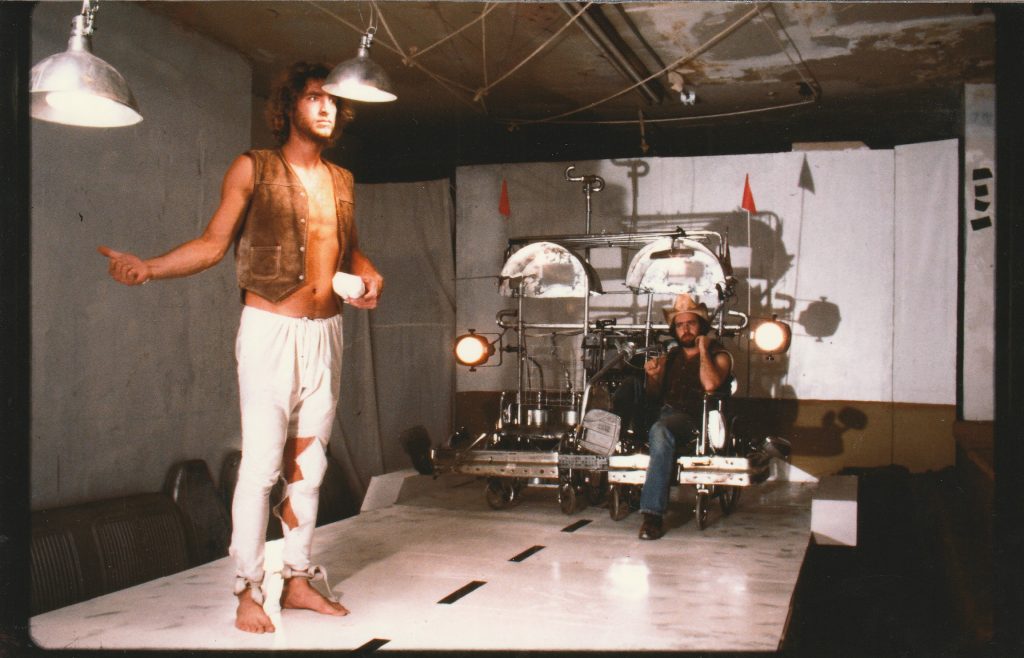
Bird of Prayer (Nick, R) and Easter Bunny (Randy, L) are Travelling Light in the Vehicle of Knowledge at ABC No Rio, 1982
As dramaturg at Dallas’s Undermain Theater in 1999, I created maybe the first ever theatre blog which, inspired also by the RAT Conference and the heady days of the “theatrosphere,” I later continued at RatSass.
But the bulk of my writing — including my autofiction Tipi on the Hill, its concomitant life-writings section Meta-memoir, as well as old and new musings on various topics — can be found on Substack. Follow me there.